1 Product Introduction
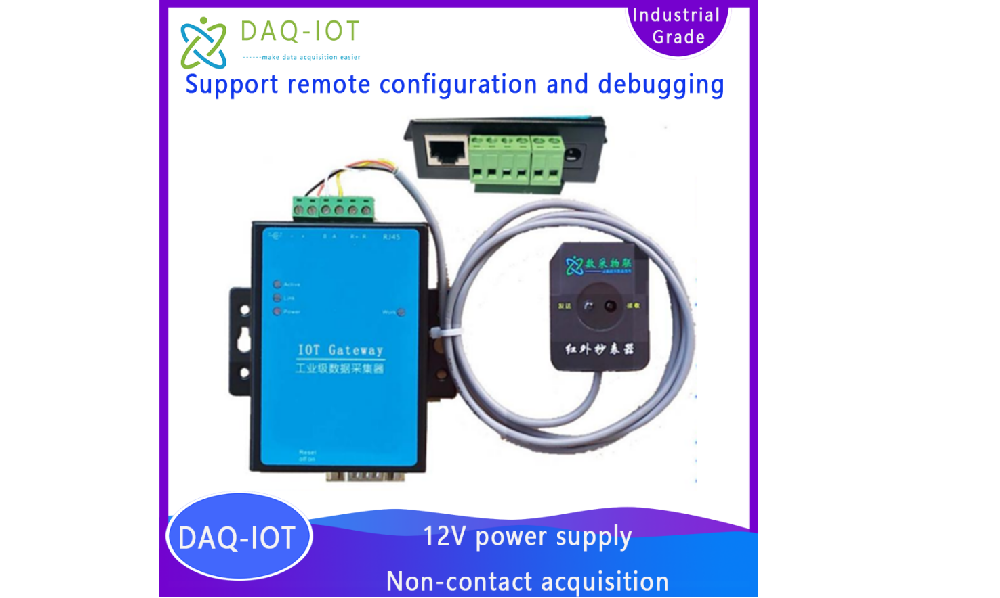
SC-GP-IR LAN Ethernet infrared meter reader is a product launched by Shanghai Shucai IoT Technology Co., Ltd. for the DLT645 to JSON function of electricity meter collection . It automatically collects data from DLT 645 meters, converts it into JSON format and sends it to the cloud server. It supports 1 Ethernet interface and RS485 serial port. The high-quality power supply design with a wide voltage of 9~24V provides better adaptability to industrial environments , and the DIN rail mounting accessories that can be equipped are suitable for DIN rail installation.
2 Service Concept
Our company solemnly promises:
You buy not only the product, but also the meticulous and thoughtful technical support service ! ! ! ( =^_^= )
This product only needs ordinary workers to connect the power and install it on site! No debugging is required!
We provide free remote guidance, remote configuration and debugging services, and send data to the user's designated cloud platform.
Free IoT solution consulting services!
3 Implementation Standards
"Q/GDW 1365-2013 Technical Specification for Security Certification of Smart Electricity Meter Information Exchange" State Grid Standard
《Multi-function Electric Energy Meter Communication Protocol DLT645-2007》 National Standard
"Three-phase smart energy meter type specification Q/GDW1356-2013" State Grid Standard
4 Technical Parameters
4.1 Appearance
Interface: 485: Terminal block; 422: Terminal block
Power supply: positive inside and negative outside, standard power socket; two-wire terminal
Size: L x W x H = 9.4cm x 6.5cm x 2.5cm
Panel lights: 1. ACT: When the ACT light is green, it means that data is being transmitted normally between Ethernet and RS485. When the ACT light flashes blue, it means that data is being returned from RS485 to Ethernet. If the data is short, the blue flashing time is short, so you need to pay attention.
2. LINK: When the LINK light is green, it means the RJ45 network cable is connected. When the LINK light is blue, it means the TCP connection is established or in UDP mode.
3. POWER: Indicates that the serial port server is powered on.
4.2 Serial port parameters
Baud rate: 1200~115200bps
Parity : None, Odd, Even, Mark, Space
Data bits: 5 to 9
4.3 Environmental requirements
Operating temperature: -40~85℃
Storage temperature: -45~165℃
Humidity range: 5~95% relative humidity
4.4Software parameters
Network protocols: TCP/UDP/ARP/ICMP/DHCP/DNS/HTTP
Communication method: Socket
User Configuration: Windows Configuration Tool Configuration tool
5 Core advantages of products
u Simple installation and quick deployment help IoT projects to be implemented quickly
u Supports full-duplex, high-speed data forwarding without packet loss.
u Non-intrusive collection, does not affect the normal operation of the equipment
u Free Windows virtual serial port & device management tool Configuration tool, supports virtual serial ports, and can search for devices and modify parameters with one click.
u Support sending data in josn format
6 Data reporting communication protocol
6.1 Protocol analysis instructions
UDP/TCP and other push methods,
Example of a data message in JSON format:
{"Energy": 3456 . 71 }
Message analysis:
{
"Energy" : 3456.71 , //Total electrical energy, unit degree
}
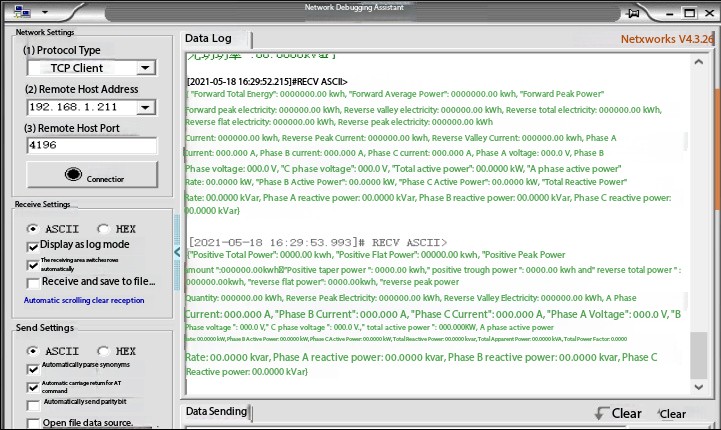
Multi-parameter acquisition version data format:
{
"Fflat": 0, //positive flat charge
"Fpeak": 28.91, //Forward peak power
"Fsharp": 105.6, //positive sharp charge
"Ftotal": 105.15, //Total forward power
"Fvalley": 23.29, //Forward valley power
"Rflat": 0, //Reverse flat power
"Rpeak": 0, //Reverse peak power
"Rsharp": 0, //Reverse sharp power
"Rtotal": 0, // total reverse power
"Rvalley": 0, //Reverse valley level power
"actPower": 13.715, //Total active power
"actPowerA": 4.524, //Phase A active power
"actPowerB": 0, //B phase active power
"actPowerC": 9.191, //C phase active power
"currentA": 40, //A phase current
"currentB": 70, //B phase current
"currentC": 50, //C phase current
"fac": 0.414, // Total power factor
"facA": 0.707, // Phase A power factor
"facB": 0, //B phase power factor
"facC": 0.707, //C phase power factor
"lastMRtotal": 0, //Total reverse power last month
"lastMtotal": 0, //Total forward power last month
"reactPower": 13.715, //Total reactive power
"reactPowerA": 4.524, //A phase reactive power
"reactPowerB": 0, //B phase reactive power
"reactPowerC": 9.191, //C phase reactive power
"volA": 210, //A phase voltage
"volB": 221, //B phase voltage
"volC": 217 //C phase voltage
}
6.2 Protocol reception test
The network debugging assistant NetAssist can be used to perform reception tests.
6.3 Protocol customization
If you need to customize other communication protocols, please contact our sales staff.
FAQ – Network Port Infrared Meter Reader (DLT645 / IEC 62056 / ANSI)
1. What is a Network Port Infrared Meter Reader?
A Network Port Infrared Meter Reader is a smart metering communication device used to read data from electrical, water, or gas meters via infrared optical ports. It supports multiple industrial protocols such as DLT645, IEC 62056, and ANSI standards for utility data acquisition.
2. What is it used for?
It is used for remote and local meter data reading, including:
Electricity consumption monitoring
Water and gas meter data collection
Industrial energy management systems
Smart grid and IoT data acquisition
Utility billing and monitoring systems
3. Which communication standards does it support?
This infrared meter reader supports multiple international and regional standards:
DL/T 645 (DLT645-1997 / 2007) – widely used in China smart meters
IEC 62056-21 (IEC 1107 / DLMS/COSEM) – international smart metering standard
ANSI C12.18 / C12.19 – North American utility meter communication standard
4. How does the infrared reading work?
The device uses an optical infrared interface that communicates with the meter’s IR port. It sends and receives data via light signals, ensuring safe, non-contact communication without direct wiring.
5. What devices can it connect to?
It can connect to:
6. What is the difference between DLT645, IEC 62056, and ANSI?
DLT645: Common in China, uses structured frame communication
IEC 62056: International standard using OBIS codes and ASCII-based communication
ANSI C12: Common in North America with register-based data format
The device supports multi-protocol switching depending on the meter type.
7. Does it support network communication?
Yes. The meter reader can transmit data via network ports (Ethernet or gateway integration), enabling remote data collection, SCADA integration, or cloud-based IoT platforms.
8. Can it be used for remote monitoring systems?
Yes. It is designed for integration into:
SCADA systems
IoT energy management platforms
Cloud-based meter data systems
Smart grid monitoring solutions
9. Is installation complicated?
No. The device uses a magnetic optical head that attaches directly to the meter’s infrared port. No wiring modification is required, making installation fast and safe.
10. What industries use this infrared meter reader?
It is widely used in:
Smart grid and utility companies
Industrial energy monitoring
Power distribution systems
Water and gas utility management
Smart city infrastructure
Substation and energy automation systems
11. Does it support real-time data reading?
Yes. It supports real-time or periodic data acquisition depending on meter protocol and system configuration.
12. Can multiple meters be read in one system?
Yes. Multiple infrared meter readers can be connected via network or IoT gateway to build a centralized multi-meter monitoring system.
13. What is the advantage of infrared (optical) reading?
Non-contact safe communication
No wiring required
High compatibility with utility meters
Stable data transmission
Suitable for sealed metering systems
14. Is it compatible with IoT platforms?
Yes. It can be integrated with IoT gateways, cloud platforms, and energy management systems using Modbus, MQTT, or TCP/IP communication (depending on configuration).
 ch
 English