1 Product Overview
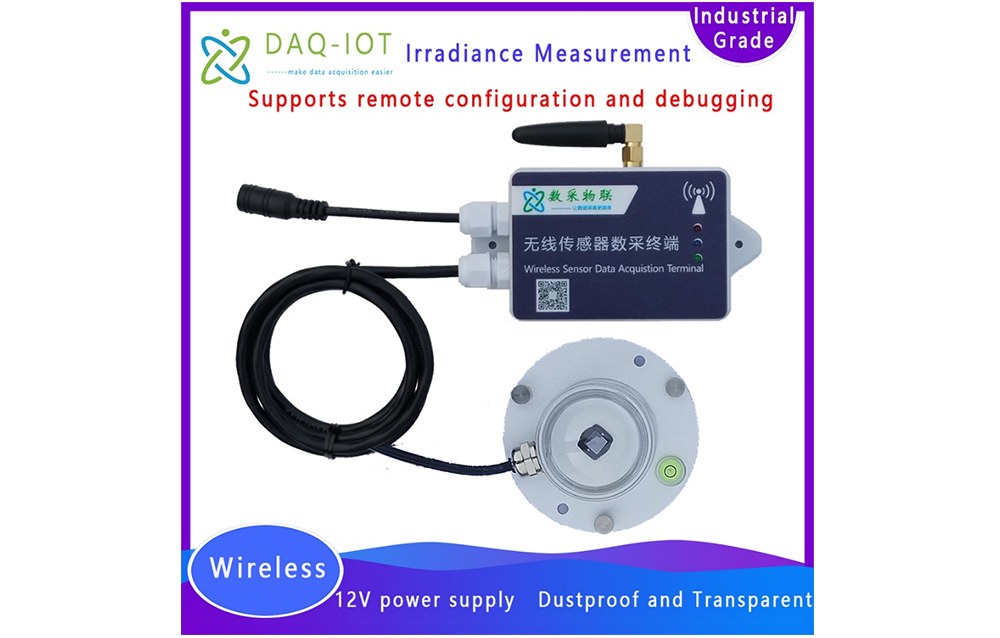
DAQ-GP-LR4G wireless irradiance sensor terminal is a wireless solar radiation measurement product launched by Shanghai Data Acquisition IOT Technology Co., LTD. The sensor uses the photoelectric principle and can be used to measure solar radiation in the spectral range of 0.3~3μm. The radiation sensor adopts high-precision sensor, wide spectrum absorption, high absorption in the full spectrum range, and good stability; At the same time, the induction element is installed outside the dustproof cover with a light transmittance of up to 95%. The dustproof cover adopts special treatment to reduce dust adsorption, effectively prevent the interference of environmental factors on the internal components, and can accurately measure the amount of solar radiation.
DAQ-GP-LR4G can directly read the current solar radiation value, and the connection mode is simple. Small and beautiful appearance, occupy a small installation space. The products are widely used in solar energy utilization, meteorology, agriculture, aging of building materials and air pollution and other departments to measure solar radiation energy.
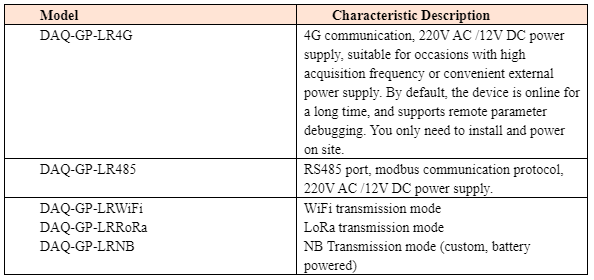
By default, the sensor terminal supports 4G/WiFi/LoRa and other communication methods, and supports MQTT, HTTP and other communication methods, which can overcome the wireless communication block caused by the special environment on the site, greatly simplifying the field deployment time and reducing construction costs.
2 Service Concept
We solemnly promise that:
What you buy is not only the product, but also the meticulous and thoughtful technical support services!!!( =^_^= )
This product, the site only ordinary workers connected to electricity installation! No debugging!
We provide free remote guidance, remote configuration and debugging service, and send the data to the user-specified cloud platform.
Free Internet of Things solution consulting services!
3 Product Features
3.1 Acquisition characteristic
Collection Type: solar radiation
Range: 0~2000W/m^2, other ranges can be customized
Wavelength Range: 400-1100nm
Resolution: 1 W/m^2
Accuracy: ±5%
Collection Frequency: 1 second to 24 hours. Remote configuration is supported
3.2 Electrical Character
Power Supply Mode:7V~30V DC
Power issipation:0.06W
3.3 Communication Characteristics
Wireless Transmission Mode: 4G /LoRa / WiFi
Communication Protocol: MQTT / TCP / UDP / HTTP / SSL / ModBus RTU, and other protocols can be customized
Data Forwarding: any public network server
Number of Server Centers: up to simultaneous data reporting to 7 cloud servers.
Heartbeat Packet: support custom heartbeat packet, can be set to signal intensity.
Registration Package: support custom registration package, can be set to IMEI code.
Positioning: Support LBS base station positioning to facilitate the query of device location.
3.4 Structural Property
Material: PC plastic (enclosure)
Main Protection Level: IP65,Work in dust, rain and snow environments
Main Body Size:200mm×94mm×60mm
Main Mounting Method: wall hanging or screw fastening
3.5 Work Environment
Ambient Temperature: -25°C~60°C
Humidity: 0%~100%RH
4 Product Core Advantages
v Simple installation, fast deployment, help the Internet of things project quickly landing.
v Using waterproof breathable film, effectively prevent dust from entering, good breathability
v Support custom registration package and heartbeat package, facilitate the platform to distinguish devices.
v Support any private Internet of Things cloud platform and configuration software, and provide data protocol docking.
v Support Ali cloud, Baidu Tiangong, OneNet, Tencent Cloud and other mainstream cloud platforms.
v Non-invasive measurement, which does not affect the normal operation of the equipment.
v Support remote configuration parameters and FOTA remote upgrade to minimize the personnel cost of site construction and maintenance.
5 Data Reporting Communication Protocol
5.1 Protocol Parsing Instructions
For UDP / TCP / MQTT / HTTP and other push methods, users should provide the public network IP (or domain name) address and port number of the cloud server to receive the data.
Example of JSON format:
{"light radiation":731,"ID":"860344048491162"}
Message analysis:
{
"light radiation": 731, //Light radiation, W/m^2
"ID": "860344048491162" // Device ID
}
5.2 Agreement Customization
If you need to customize other communication protocols, you can contact the business personnel to communicate them.
6 Platform Docking
6.1 Default Platform
The product is connected to our designated industrial Internet of Things platform by default, and the platform interface is as follows:
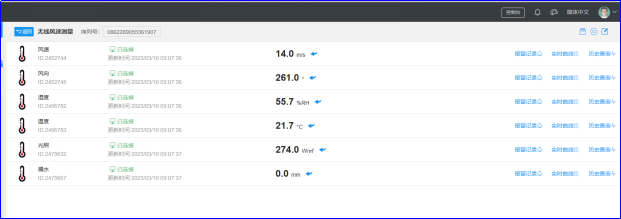
Computer-side browser interface
6.2 The User Specifies the Platform
Take the connection of Ali Cloud platform as an example. After users create products and add devices on the Ali Cloud Internet of Things platform, users need to provide a triad: {ProductKey, DeviceName, DeviceSecret} and the MQTT theme to be released.
For example, the value of triples is:
ProductKey = b0FMK1Ga5cp
DeviceName = 862991419835241
DeviceSecret = y7MTCG6Gk33Ux26bbWSpANl4OaI0bg5Q
FAQ – RS485 / LoRa / WiFi Wireless Solar Irradiance Detection Sensor (Dust-proof)
(PV Power Plant & EPC Engineering Procurement Version)
1. What is a solar irradiance sensor used for in PV power plants?
A solar irradiance sensor is used to measure the intensity of sunlight (W/m²) in photovoltaic power plants. It is a key device for evaluating PV system performance, calculating efficiency (PR), and supporting energy yield analysis.
2. Why is solar irradiance measurement important for EPC projects?
For EPC contractors and power plant operators, solar irradiance data is essential for:
Performance Ratio (PR) calculation
Energy yield forecasting
PV module efficiency evaluation
Plant commissioning and acceptance testing
Long-term performance monitoring
3. What communication interfaces does this sensor support?
The sensor supports multiple industrial communication options:
RS485 (Modbus RTU) for SCADA integration
LoRa / LoRaWAN for long-range wireless deployment
WiFi for local network monitoring
Optional IoT protocols (MQTT / HTTP)
4. Can this sensor be integrated into SCADA systems?
Yes. The RS485 Modbus RTU interface allows seamless integration with SCADA systems, data loggers, PLCs, and centralized PV monitoring platforms.
5. Is it suitable for utility-scale solar power plants?
Yes. It is designed for utility-scale PV plants, including:
Ground-mounted solar farms
Distributed PV systems
Rooftop solar monitoring systems
Hybrid renewable energy plants
6. What is the measurement range of the irradiance sensor?
The standard measurement range is:
7. How accurate is the sensor?
Typical accuracy is:
8. Is the sensor suitable for harsh outdoor environments?
Yes. It features:
IP65 / IP67 dust-proof and waterproof protection
UV-resistant industrial housing
Anti-corrosion design
Stable operation under high temperature, humidity, and dust conditions
9. Can it operate in remote solar farms?
Yes. With LoRa or low-power design options, the sensor is ideal for remote PV plants without stable wired communication infrastructure.
10. What is the installation method?
Installation is simple and EPC-friendly:
Pole-mounted or bracket-mounted
Horizontal alignment required for accurate cosine response
No complex wiring for wireless versions (LoRa / WiFi models)
11. Does it support real-time data monitoring?
Yes. The sensor provides real-time or scheduled data transmission to SCADA systems or cloud platforms for continuous PV performance monitoring.
12. Can multiple sensors be deployed in one PV plant?
Yes. Multiple irradiance sensors can be installed across different PV arrays and centrally managed through SCADA or IoT platforms.
13. What power supply options are available?
The sensor supports multiple power options:
DC 9–36V (standard industrial power)
Battery-powered (long-life option)
Solar-powered auxiliary supply (optional for off-grid systems)
14. What are the main applications in EPC projects?
It is widely used in:
Solar PV power plants (utility-scale)
EPC project commissioning and testing
Performance ratio (PR) monitoring systems
Weather monitoring stations for solar farms
Energy yield analysis systems
15. What are the key advantages for EPC contractors?
Easy integration with SCADA and monitoring systems
Multi-protocol support (RS485 / LoRa / WiFi)
High reliability for long-term outdoor operation
Dust-proof industrial design for harsh environments
Suitable for large-scale PV deployment
Supports performance verification and compliance testing
16. Does it require frequent maintenance or recalibration?
No frequent maintenance is required. The sensor is factory calibrated and designed for long-term stable operation. Periodic cleaning of the sensor surface is recommended in dusty environments.
 ch
 English