1 Product Introduction

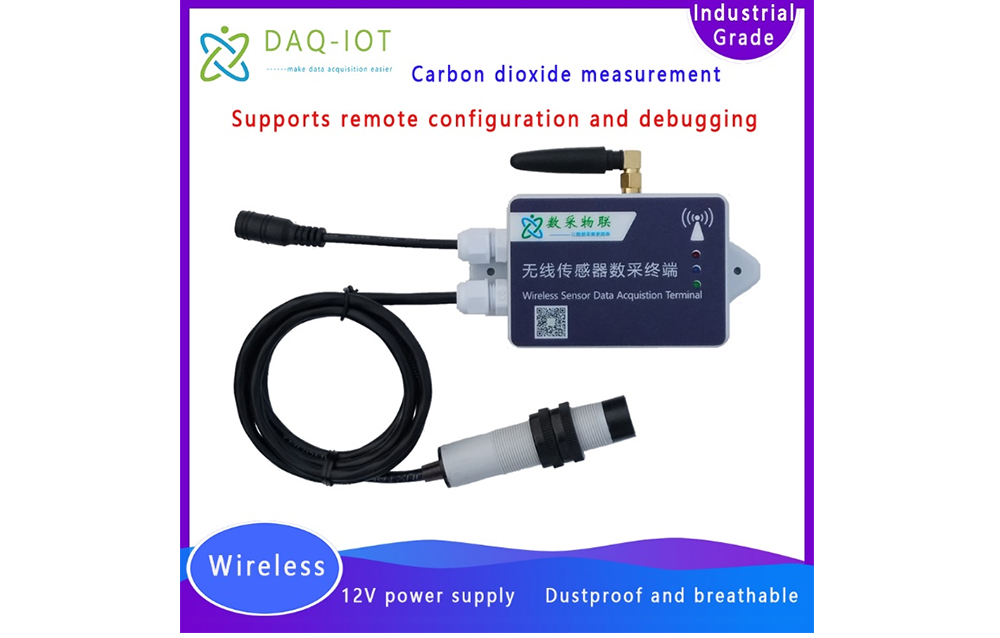
DAQ-GP-CO24G wireless infrared carbon dioxide sensor terminal is a wireless carbon dioxide concentration measurement product launched by Shanghai Data Acquisition IOT Technology Co., LTD. Principle: This product uses the non-dispersive infrared (NDIR) principle to detect CO2 present in the air. Since different kinds of gases absorb specific wavelengths of infrared light, the relationship between gas concentration and absorption intensity (Lambert-Beer law) is used to identify gas components and determine their concentration, which has the advantage of being less susceptible to environmental interference than chemical sensors.
The equipment is mainly composed of infrared light source, optical path, infrared detector, optical sensor composed of software algorithm and its supporting wireless transmission protocol processing part. This product can be widely used in gas pipeline, intelligent agricultural breeding, chemical plants, production workshops and other fields of carbon dioxide concentration monitoring.
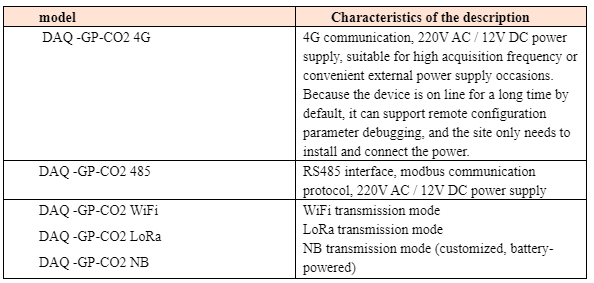
By default, the sensor terminal supports 4G/WiFi/LoRa and other communication methods, and supports MQTT, HTTP and other communication methods, which can overcome the wireless communication block caused by the special environment on the site, greatly simplifying the field deployment time and reducing construction costs.
2 Service Concept
We solemnly promise that:
What you buy is not only the product, but also the meticulous and thoughtful technical support services!!!( =^_^= )
This product, the site only ordinary workers connected to electricity installation! No debugging!
We provide free remote guidance, remote configuration and debugging service, and send the data to the user-specified cloud platform.
Free Internet of Things solution consulting services!
3 Product Features
3.1 Temperature Acquisition Characteristics
Type: CO2 concentration
Range: 400~5000 ppm, other ranges can be customized
Accuracy: ±3%F.S.
Acquisition Frequency: 1 second ~24 hours, support remote configuration
3.2 Electrical Character
Power Supply Mode: battery power supply or 12V DC / 220V AC
3.3 Communication Characteristics
Wireless Transmission Mode: 4G /LoRa / WiFi
Communication Protocol: MQTT / TCP / UDP / HTTP / SSL / ModBus RTU, and other protocols can be customized
Data Forwarding: any public network server
Number of Server Centers: up to simultaneous data reporting to 7 cloud servers.
Heartbeat Packet: support custom heartbeat packet, can be set to signal intensity.
Registration Package: support custom registration package, can be set to IMEI code.
Positioning: Support LBS base station positioning to facilitate the query of device location.
3.4 Structural Property
Material: PC plastic (enclosure)
Main Protection Level: IP65, dust, rain and snow environment can work
Main Body Size: 200mm 94mm 60mm
Temperature Measuring Probe Structure: patch type
Main Body Installation Method: wall hanging or screw fastening
Probe Installation Method: paste or screw tightening, binding belt installation
3.5 Work Environment
Ambient Temperature: -30°C~85°C
Humidity: 0~95% (non-condensing)
4 Product Core Advantages
v Simple installation, fast deployment, help the Internet of things project quickly landing.
v Using waterproof breathable membrane, effectively prevent dust entry, good air permeability.
v Support custom registration package and heartbeat package, facilitate the platform to distinguish devices.
v Support any private Internet of Things cloud platform and configuration software, and provide data protocol docking.
v Support Ali cloud, Baidu Tiangong, OneNet, Tencent Cloud and other mainstream cloud platforms.
v Non-invasive measurement, which does not affect the normal operation of the equipment.
v Support remote configuration parameters and FOTA remote upgrade to minimize the personnel cost of site construction and maintenance.
5 Data Reporting Communication Protocol
5.1
For UDP / TCP / MQTT / HTTP and other push methods, users should provide the public network IP (or domain name) address and port number of the cloud server to receive the data.
Example of JSON format:
{"CO2":731,"ID":"860344048491162"}
Message analysis:
{
"CO2": 731, / / CO2 gas concentration value, unit in ppm
"ID": "860344048491162" / / Device ID
}
5.2
If you need to customize other communication protocols, you can contact the business personnel to communicate them.
6 Platform Docking
6.1 Default Platform
The product is connected to our designated industrial Internet of Things platform by default, and the platform interface is as follows:
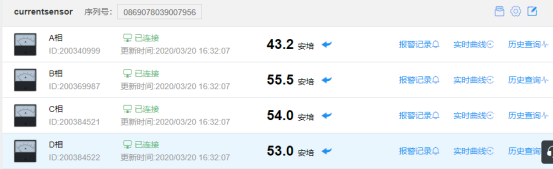
Computer-side browser interface
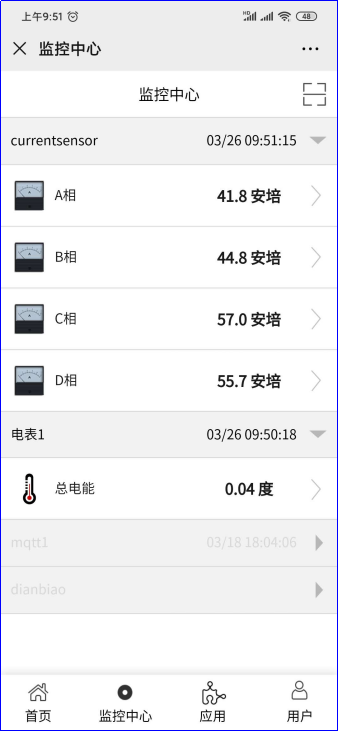
Mobile terminal WeChat access interface
6.2 The User Specifies the Platform
Take the connection of Ali Cloud platform as an example. After users create products and add devices on the Ali Cloud Internet of Things platform, users need to provide a triad: {ProductKey, DeviceName, DeviceSecret} and the MQTT theme to be released.
For example, the value of triples is:
ProductKey = b0FMK1Ga5cp
DeviceName = 862991419835241
DeviceSecret = y7MTCG6Gk33Ux26bbWSpANl4OaI0bg5Q
FAQ – WiFi / RS485 / LoRa Wireless CO₂ Sensor for Measuring Gaseous Carbon Dioxide (CO₂) Concentration
1. What is a Wireless CO₂ Sensor?
A Wireless CO₂ Sensor is an industrial IoT device that continuously measures carbon dioxide (CO₂) concentration in the air and transmits data via RS485, LoRa, or WiFi for real-time monitoring and analysis.
2. What sensing technology does the CO₂ sensor use?
The sensor uses advanced NDIR (Non-Dispersive Infrared) technology, which provides highly accurate, stable, and long-lasting CO₂ measurements with minimal maintenance requirements.
3. Why is CO₂ monitoring important?
Monitoring CO₂ levels helps:
Improve indoor air quality (IAQ)
Optimize HVAC ventilation systems
Reduce energy consumption
Improve workplace comfort and productivity
Enhance greenhouse crop growth
Maintain healthy indoor environments
4. What is the measurement range of the sensor?
Typical measurement ranges include:
Custom ranges are available upon request.
5. How accurate is the CO₂ sensor?
Typical measurement accuracy:
This makes it suitable for both commercial and industrial monitoring applications.
6. What communication methods are supported?
The sensor supports:
This allows flexible deployment across various monitoring systems.
7. Can the sensor be integrated with SCADA or BMS systems?
Yes.
The sensor can be integrated with:
SCADA systems
Building Management Systems (BMS)
Energy Management Systems (EMS)
Industrial IoT Platforms
Smart Building Platforms
Cloud Monitoring Dashboards
8. Is the sensor suitable for greenhouse applications?
Yes.
The sensor is widely used in:
where maintaining optimal CO₂ levels is critical for plant growth and yield.
9. Can it be used for HVAC demand-controlled ventilation (DCV)?
Yes.
The sensor is ideal for:
Demand-Controlled Ventilation (DCV)
Air handling unit control
Ventilation optimization
Energy-saving building automation
by adjusting fresh air intake based on actual CO₂ concentration.
10. Does the sensor support remote monitoring?
Yes.
Users can remotely monitor:
Real-time CO₂ levels
Historical trends
Alarm events
Device status
through cloud platforms, mobile apps, or web dashboards.
11. Can the sensor trigger alarms?
Yes.
Alarm thresholds can be configured for:
High CO₂ concentration
Low CO₂ concentration
Sensor faults
Communication failures
Notifications can be sent via platform alerts, email, SMS, or API integrations.
12. Is the sensor suitable for industrial environments?
Yes.
Industrial versions offer:
High anti-interference capability
Long-term operational stability
Wide operating temperature range
Industrial-grade housing
Optional IP65 waterproof protection
13. What power supply options are available?
Depending on the model, the sensor can support:
DC 9–36V
12VDC
24VDC
Battery-powered version
Solar-powered version
for flexible installation in remote locations.
14. Can multiple sensors be managed from a single platform?
Yes.
A centralized monitoring platform can manage:
from a single dashboard.
15. What additional environmental parameters can be measured?
Optional integrated sensors include:
Temperature
Relative Humidity
PM2.5
PM10
TVOC
Atmospheric Pressure
Formaldehyde (HCHO)
This enables complete indoor air quality monitoring.
16. How often should the sensor be calibrated?
NDIR sensors offer excellent long-term stability.
Typical recommendations:
17. What industries commonly use CO₂ sensors?
Smart Buildings
Offices
Schools
Hospitals
Shopping malls
Agriculture
Greenhouses
Hydroponics
Vertical farms
Industrial Applications
Manufacturing facilities
Warehouses
Laboratories
Environmental Monitoring
IAQ projects
Smart city deployments
Public infrastructure
18. Why choose this Wireless CO₂ Sensor?
Key benefits include:
High-accuracy NDIR technology
RS485 Modbus RTU support
LoRa and WiFi wireless connectivity
Real-time cloud monitoring
Easy SCADA and BMS integration
Low maintenance requirements
Long sensor lifespan
Suitable for industrial, agricultural, and commercial projects
 ch
 English